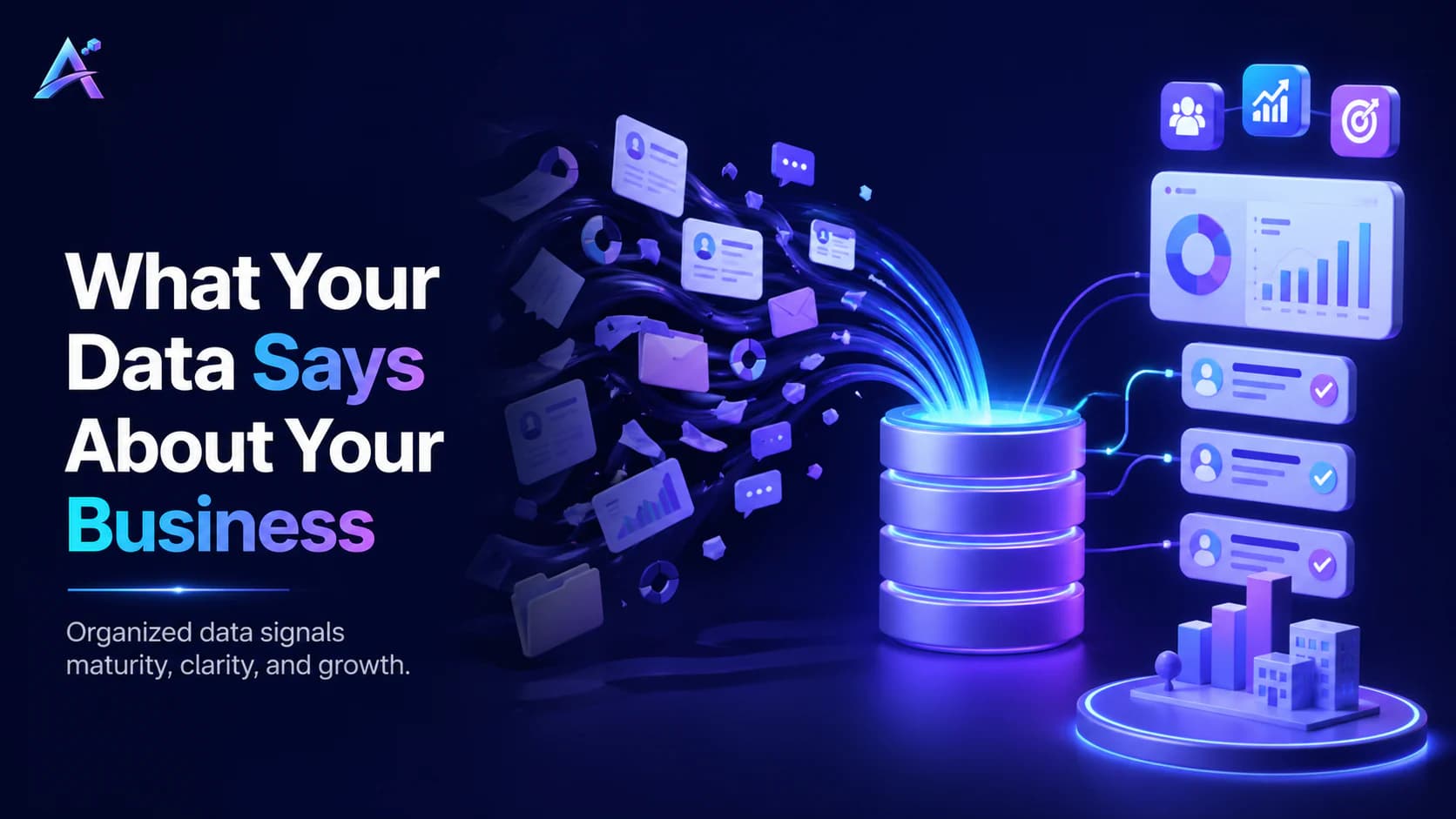
The way a business handles its data says a lot about how it operates overall. Organizing your customer base, reports and communication is not a technical matter, it is a matter of maturity. Below we break down what the state of a business's data reveals about its level and its capabilities.
1. It shows whether a process exists
Businesses with fragmented data usually do not have clear processes. Businesses with organized data have established a way of operating. The picture of the data reflects the picture of the processes.
Orderly data presupposes orderly work. It is not the result of luck.
2. It shows whether you make decisions based on evidence
When data is organized, decisions rest on facts. When it is fragmented, they rest on gut feeling. The quality of the decision becomes apparent over time.
Businesses that operate on data have a demonstrably better ability to adapt to conditions.
3. It shows how dependent you are on specific individuals
When knowledge about customers lives in the minds of a few people, the business is vulnerable. When it lives in a system, the business has continuity regardless of staff changes.
Knowledge should belong to the business and not to individual employees.
4. It shows how you manage scale
Businesses with disorganized data struggle to grow without their operations breaking down. Data organization is a prerequisite for sustainable growth.
Without a solid data foundation, every new level of growth creates more problems than it solves.
5. It shows how seriously you take the customer experience
Knowing a customer's history is what allows for consistent and professional service. Businesses that do not have this knowledge show that they consider the customer experience secondary.
When the business knows the customer, the customer perceives it and responds with loyalty.
6. It shows whether you are ready for digital transformation
A business's digital maturity starts with its data. Without organized data, there is no meaningful foundation for AI, automation or advanced reporting.
Technology delivers results only when applied to a solid data foundation. Otherwise it reproduces the chaotic situation faster.
Conclusion
Data organization is not a detail. It is an indicator of maturity, decision-making capability and readiness to grow. Businesses that pay attention to their data build on the right foundation.
A mature CRM is the tool that turns this attention into a daily operation. See how Argonstack CRM gives structure to your business's data.