The perception that a CRM is only for large teams remains widespread. In practice, small businesses and freelancers are the ones who stand to gain the most in relative terms. Below we break down why a CRM is useful in these cases too, and how it changes day-to-day operations.
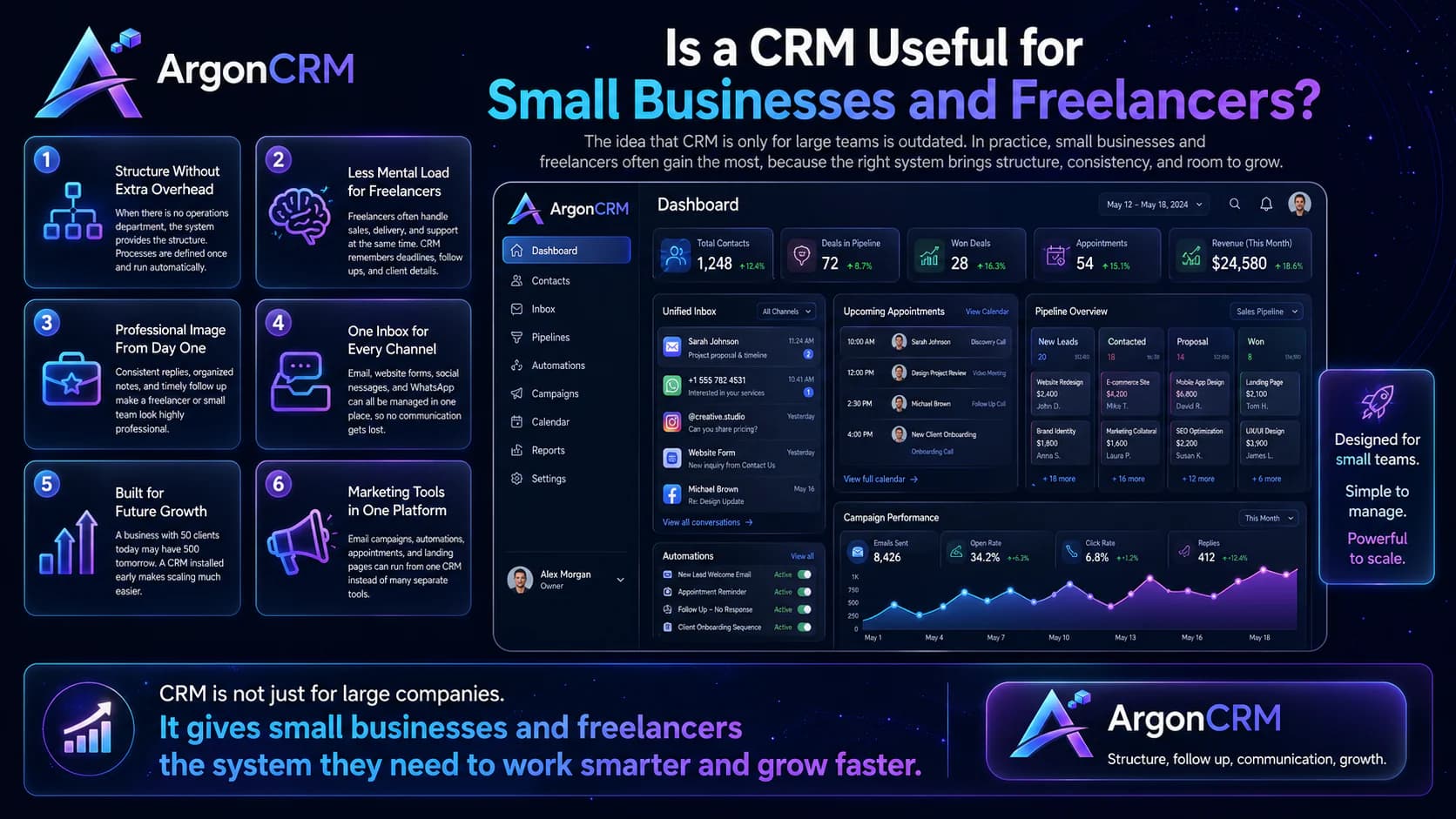
1. It brings structure to businesses without a large infrastructure
When there is no operations department to oversee processes, the structure has to come from the system itself. A CRM plays that role, without requiring additional staff.
Processes are defined once within the system and run automatically. They don't require constant oversight.
2. It covers freelancers who keep everything in their heads
The freelancer is often salesperson, project manager and support all at once. The CRM offloads reminders, customer details and next steps from their mind.
When the system remembers deadlines and follow-ups, the professional can focus on the work itself instead of managing it.
3. It presents a professional image from day one
A freelancer or a small team using a CRM responds consistently, records agreements and follows up on time. That consistency builds trust.
The customer doesn't perceive a difference between a solopreneur who has a system and an organized company. It's the communication experience that counts.
4. It manages every communication channel
Email, social media messages, requests from the website, WhatsApp messages. A freelancer or small business receives communication from many channels. The CRM unifies them into a single inbox.
With a single inbox, no communication is lost and every interaction is linked to the corresponding customer.
5. It enables scalability when the time comes
The small business that has 50 customers today may have 500 tomorrow. A CRM implemented early makes it possible to scale operations without building from scratch.
Putting a CRM in place while the business is small is easier than doing it later, when the volume of data and processes is large.
6. It provides professional marketing tools
Email campaigns, automations and landing pages are no longer the exclusive domain of large brands. With a CRM like Argonstack CRM, a freelancer or small business can run a complete marketing operation from a single platform.
There's no need for separate tools for email, appointments and the customer base. Everything coexists in a single system.
Conclusion
A CRM is useful for small businesses and freelancers perhaps even more than for large organizations. It provides structure, offloads the mind, builds a professional image and lays the groundwork for growth.
The question that matters isn't whether you need a CRM, but when it will be put in place properly.
See how Argonstack CRM adapts to small teams and freelancers, with a structure that scales.